Are you an overwriter or an underwriter?
Everyone’s writing style and process is different. Some people are overwriters: writing hundreds of superfluous words which bloat their stories. So, words need to be cut in subsequent drafts. Other people are underwriters: needing to add words in later drafts to augment their stories. Which method works best?
As you may have already discovered, there is no right way to write. What works well for one person will not necessarily work well for you. Some authors write lots of words fast, to get the story down. Once they have completed their first draft they go back and cut out unnecessary sections and polish the words they are keeping. This is not my approach.
I am not an overwriter. Perhaps my training as a journalist has led to my restraint. Yet, in the edit I am currently doing on my novel, I am finding there are still passages I should cut. These are typically instances where one of my narrators is having a moment of introspection that does not advance the story.
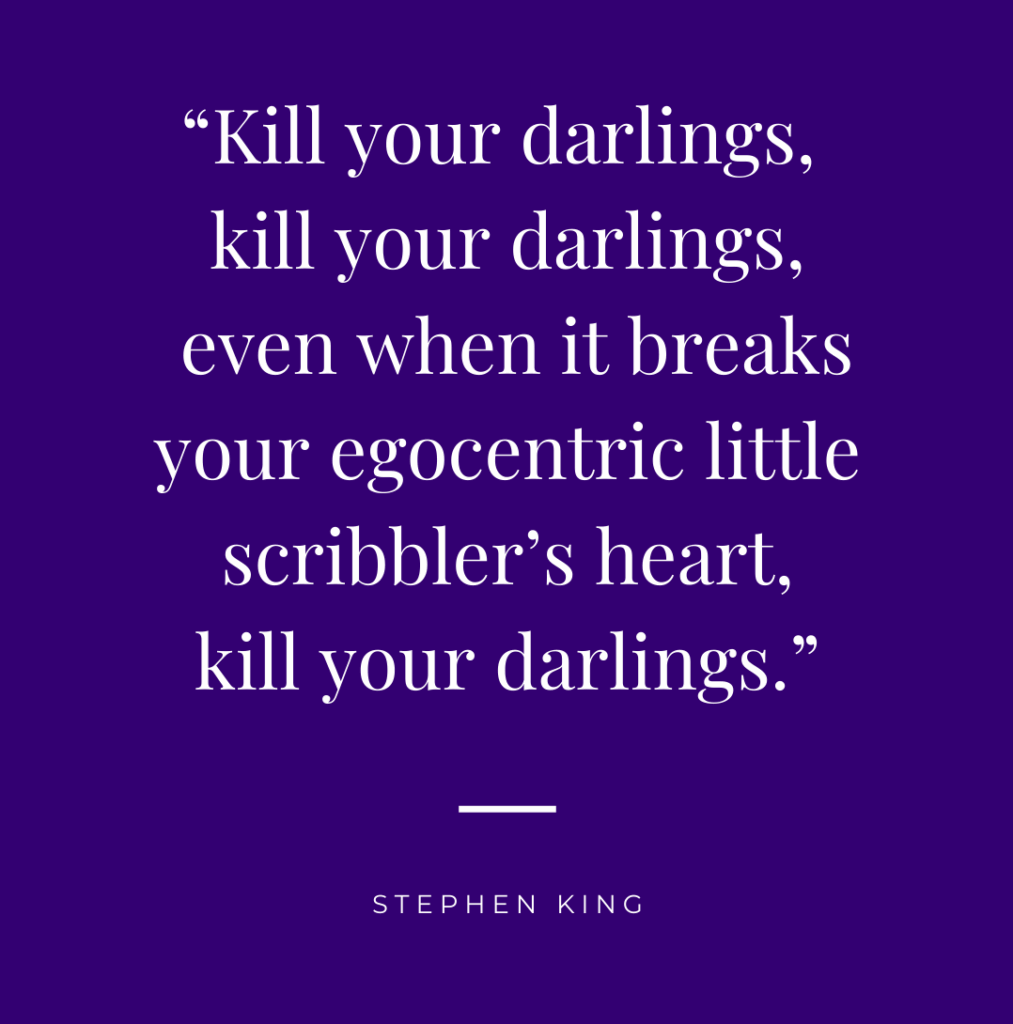
As Stephen King advises, “When you rewrite, your main job is taking out all the things that are not the story” (On Writing: A Memoir of the Craft, 2000). You need to “kill your darlings” (King, 2000). This means cutting out all the unnecessary, extraneous elements which do not advance the plot or serve the story’s purpose. This can be a painful process if you have become attached to your writing piece. To gain some emotional distance from one’s own creative writing, it helps to shelve your first draft for several weeks before editing it. Stephen King suggests a minimum of six weeks.
I have found that coming back to my novel several months after drafting it has given me the necessary perspective to edit it more dispassionately. Rereading my manuscript assessor’s report, I find myself agreeing with many of the points she raised. For instance, she said I should allow details and personalities to emerge organically rather than summarising characters. Her feedback, as well as that of my other beta readers, has been helpful.
When you do “kill your darlings”, it is worth bearing in mind that if you do it right, you will be strengthening your story. You could create an iceberg effect. As you may know, typically only one-tenth of the volume of an iceberg is above water. Ernest Hemingway employed this iceberg theory, as he termed it, in his writing. By trusting readers to make connections and sense what lies beneath the surface, writers can create more compelling stories.
Written by Gemma Franks
